

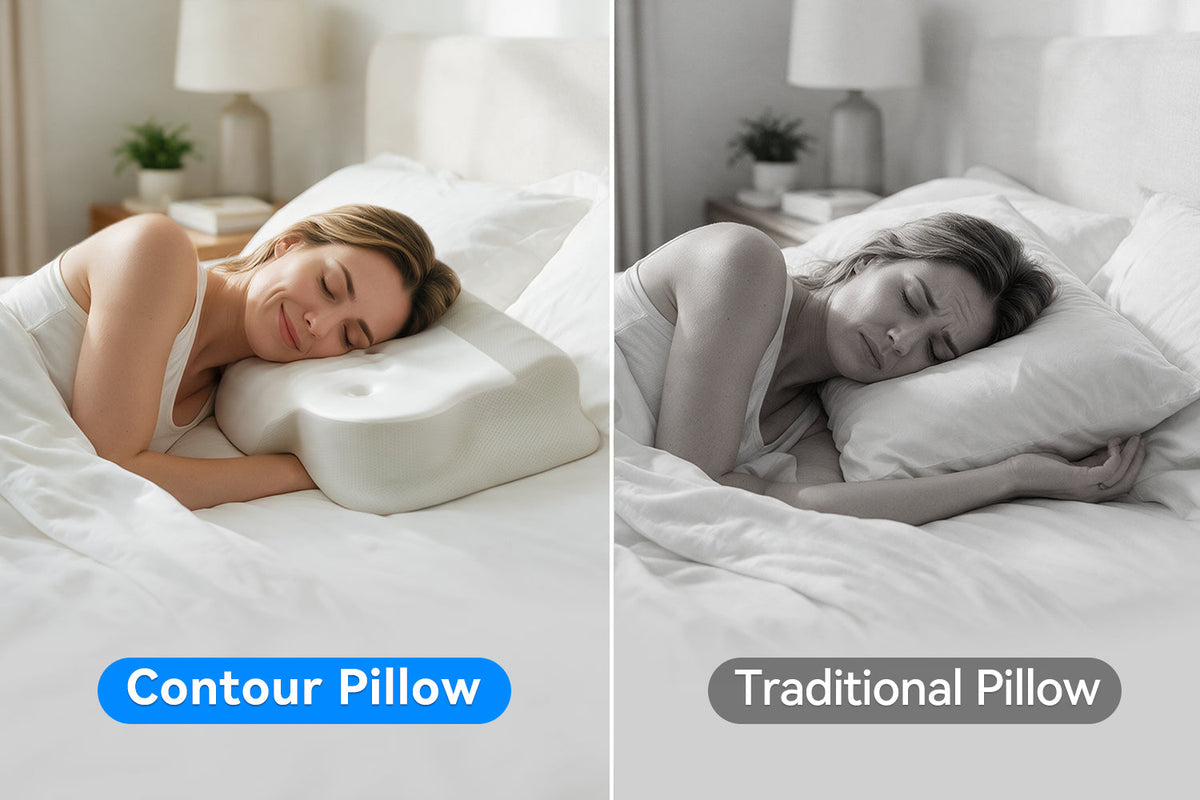
A contour pillow gives your head and neck defined resting zones, while a traditional pillow gives you a flat, flexible surface. Neither shape is right for every sleeper. The better choice depends on your shoulder gap, mattress feel, preferred sleep position, and how often you move overnight. Compare the listed loft, adjustability, and sleep-position design before deciding.
What Makes a Contour Pillow Different From a Traditional Pillow
The main difference is the surface shape. A contour pillow has raised edges and a lower center, while a traditional pillow is usually a flat rectangle with the same general surface from edge to edge.
The raised areas of a contour design can create a more consistent place for your neck and head. That can feel steady when you tend to settle in one position. The lower center can feel more natural for some back sleepers because it gives the head a place to rest without as much height directly beneath it.
A traditional pillow leaves more room to shift, bunch, fold, or turn it during the night. That freedom can be useful if you move from side to back or sleep near an edge of the pillow. It also means the support can change when the fill moves.
For a contour pillow vs. regular pillow comparison, think of defined placement versus open space. A contour shape guides where you rest. A regular shape lets you decide each time you move.
Compare Shape, Loft, Firmness, and Adjustability
Shape matters, but a pillow still has to hold the right height after you lie down. Compare these features together, because a tall soft pillow may feel lower than a shorter, firmer one after a few minutes.
| Feature | Contour Pillow | Traditional Pillow |
| Surface | Raised edges with a lower center or channel | Mostly flat, rectangular surface |
| Loft control | Often fixed by the molded shape | Can vary as fill is fluffed or shifted |
| Feel | More defined and stable | More open and adaptable |
| Firmness | Often denser to preserve the contour | Ranges from soft fill to firmer foam |
| Adjustability | Depends on removable layers or inserts | Depends on removable fill or pillow arrangement |
The table points to a practical trade-off. A contoured surface can make repeatable head placement easier, but only when its raised section matches your needed loft. A flat pillow can be simpler to reshape, but it may take more adjustment if the fill spreads or compresses.
Firmness changes both styles. A soft traditional pillow may lose too much height for a broad side sleeper. A dense contour may feel restrictive if its edge is too high. Look at compressed height, not only the label.
Adjustability can reduce the risk of a near miss. Our adjustable contour pillow includes a removable booster pad, which provides two height configurations. Review how each configuration relates to your usual sleep position and mattress feel before ordering.
How Each Pillow Style Feels in Different Sleep Positions
Your most common position should decide the starting point. Compare each shape with the positions you use most, rather than choosing by the first feature that sounds comfortable.
Side Sleeping
Side sleepers need enough height to fill the space between the mattress and the side of the head. A contour pillow for side sleepers can work when its raised edge fills that gap without lifting the head toward the ceiling.
A traditional pillow can work if it holds its height and does not flatten under the head. It may feel more forgiving if you change arm positions. Keep your shoulder on the mattress while the pillow fills the space above it.
When reviewing product details, look for a loft range that is suitable for your shoulder gap and mattress feel. A higher profile may suit a larger gap, while a lower profile may suit a smaller gap or a softer mattress.
Back Sleeping
Back sleepers often prefer less height under the head than side sleepers. A lower center can let the back of the head settle while the raised area supports the neck.
A traditional pillow may suit you if you like to change the height by moving the fill or using a thinner profile. Avoid treating a deep contour as automatically better for back sleep. If your chin tends to tip toward your chest, compare lower-profile options.
Combination Sleeping
Combination sleepers usually benefit from a middle-ground setup. A very deep contour can feel limiting if you move frequently between side and back sleeping.
Choose a contour design when you generally land in the same position and want less nightly rearranging. Choose a traditional shape when you want more surface freedom. An adjustable contour or adjustable-fill traditional pillow can be a practical compromise when its listed height range suits your primary sleep positions.
Check Whether the Pillow Height Fits Your Mattress and Shoulder Gap
The same pillow can fit differently on another mattress. A plush mattress lets your shoulder sink farther, reducing the gap the pillow needs to fill. A firm mattress keeps your shoulder higher, which may require more loft.
Start with these factors before choosing a profile:
- Shoulder width: Broader shoulders often create a larger gap in side sleeping.
- Mattress feel: Softer mattresses usually allow more shoulder sink than firm mattresses.
- Fill compression: Foam, fiberfill, and down-like fills lose height differently under pressure.
- Arm placement: An arm tucked under the pillow can make a suitable pillow feel too low or unstable.
Your goal is a neutral, relaxed position rather than a certain number of inches. A tall contour can be too high for a narrow-shouldered sleeper on a soft bed. A modest traditional pillow can be too low for a broad-shouldered sleeper on a firm bed. Personal fit beats category labels.
Consider the Trade-Offs of a Fixed Shape
A fixed shape creates consistency, but it also gives you less room to improvise. This is the central contour vs. traditional pillow trade-off: a structured surface can keep support in one place, while a flatter surface makes it easier to change where and how you rest.
Contours can take an adjustment period if you fold a pillow corner, sleep near an edge, or rotate the pillow overnight. Their raised and lowered sections may feel different when you turn.
Traditional pillows have trade-offs too. Loose fill may need refluffing, and a flat surface can let your head drift into a less supported spot. If you pile up an edge, the issue may be support retention rather than shape.
Do not force a fixed shape because it looks ergonomic. The right pillow is the one that lets you relax in your normal position without repeated repositioning or obvious head tilt.
Check Pillow Fit After It Arrives
Product details help you compare options before ordering. After the pillow arrives, a short check on your normal mattress can show whether its shape and height feel consistent with those details.
- Lie in your usual sleep position with your shoulder fully on the mattress.
- Place the pillow under your head and neck, rather than under your shoulder.
- Rest for ten to fifteen minutes before judging height or firmness.
- Check whether your head appears noticeably tipped upward or downward.
- If the pillow has an adjustable component, change only one setting at a time.
- Recheck the setup over several nights, unless it creates clear discomfort.
This check can show whether the pillow’s shape and height suit your bed. If ongoing pain, numbness, weakness, or sleep disruption concerns you, speak with a qualified health professional.
Compare Pillow Details Before You Buy
Start with the style that matches how you sleep, then compare its stated loft with your shoulder gap and mattress feel. Choose a contour pillow if defined zones suit your usual position, or a traditional pillow if you need more room to move. After delivery, check the setup on your own mattress and adjust a removable layer if the design allows it. Product details matter more than a broad category label.
Frequently Asked Questions
Q1: Can a contour pillow work if I sleep on my stomach sometimes?
Sometimes, but a raised contour can feel too tall for stomach sleeping because that position usually needs less head height. If you often sleep on your stomach, prioritize a lower listed profile and avoid a shape designed mainly for high side-sleeping loft.
Q2: Which online product details matter most when comparing pillows?
Start with the stated loft, firmness, shape, adjustable components, and intended sleep positions. Then compare those details with your shoulder gap, mattress feel, and primary position. Product care and return information can also help you make a more informed online purchase.
Q3: Does memory foam always feel firmer than fiberfill?
No. Memory foam often feels more molded and slow to rebound, but density, thickness, and the cover all affect its feel. Fiberfill can feel very soft, medium, or supportive depending on how much fill it contains and how well it is held in place.
Q4: Should I use a second pillow to make a low pillow taller?
It can create more height, but two pillows can shift apart or create an uneven surface. For a more stable setup, look for one pillow whose listed loft and support level better match your side-sleeping needs.
Q5: When should I replace a pillow instead of adjusting it?
Replace it when it stays flat, lumpy, or difficult to keep clean, and no longer returns to a supportive shape. A pillow that needs constant folding or stacking may have reached the end of its useful support, even if the cover still looks fine.


Leave a comment
This site is protected by hCaptcha and the hCaptcha Privacy Policy and Terms of Service apply.