

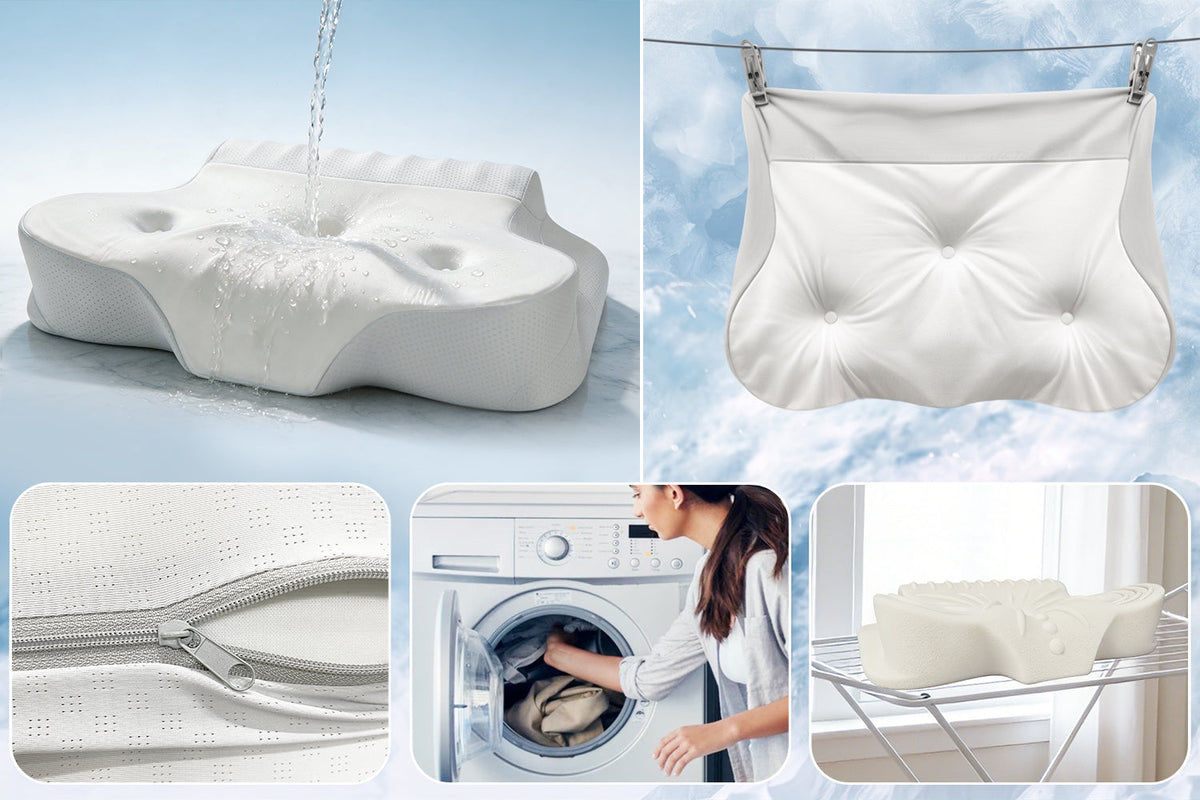
Clean a memory foam pillow with as little moisture as possible, then let it air-dry completely before it returns to your bed. The foam core usually should not be soaked, machine-washed, or put in a dryer unless its care label specifically says otherwise. Regular cover washing, light vacuuming, and quick spot-cleaning keep the pillow fresher without weakening its shape or feel.
Check the Care Label and Pillow Construction
Start with the care label, because the right cleaning method depends on the exact foam, cover, and construction in your pillow. A label can permit a washable cover while still ruling out washing the foam core. If the label and a general cleaning tip disagree, follow the label.
Solid Foam and Shredded Foam Need Different Care
Solid memory foam is one molded piece, so water can travel into the center and take a long time to leave. It is more likely to lose its shape or remain damp if it is soaked. Treat it with surface cleaning and limited spot treatment unless the manufacturer gives other directions.
Shredded foam contains loose pieces inside an inner shell. Some shredded-foam pillows may have a care method that differs from a solid core, but the fill can still clump when it gets very wet. Check whether the label refers to the whole pillow, the inner liner, or only the outer cover before doing anything with water.
Why the Manufacturer’s Instructions Come First
The manufacturer knows which fabrics, adhesives, foam density, and closures are in that model. Its instructions may also tell you whether a stain treatment is acceptable and how long drying can take. Save a photo of the care tag before washing a faded label, especially if your pillow has a removable insert or more than one layer.
If the label is missing, choose the gentlest route: clean only the affected area, use a barely damp cloth, and allow plenty of ventilation. A full wash is a bigger risk than a small, visible spot.
Know What Not to Put in a Washer or Dryer
Keep the foam core out of the washer and dryer unless its own label explicitly permits those steps. Agitation can tear or distort foam, while dryer heat can change its texture and trap heat inside before the center is dry. A pillow that looks dry on the surface may still hold moisture deep inside.
Avoid these common shortcuts when the foam itself needs care:
- Do not submerge or soak the pillow in a tub or sink.
- Do not run the foam core through a washer, even on a gentle cycle.
- Do not tumble-dry it or place it on a radiator, heating pad, or other direct heat source.
- Do not use bleach, strong solvents, or heavily scented sprays that leave residue in the foam.
- Do not wring, twist, or press the pillow hard enough to deform the core.
These limits protect the pillow's structure and make complete drying more realistic. The removable textile layers are different. For example, our contoured memory foam pillow has a zippered, removable outer pillowcase that can be machine-washed according to its product instructions. Treat that as cover care, not permission to wash the foam core.
Refresh the Pillow Without Soaking It
Refresh a memory foam pillow with dry, low-impact care first. Most routine odor and dust concerns do not require a wet wash, and a few minutes of surface care is easier to repeat than a deep-cleaning attempt.
Vacuuming and Deodorizing the Foam Surface
Remove the case and any washable cover, then use the upholstery brush on a vacuum at low suction. Move it slowly across both sides, the seams, and any contour areas. This lifts loose dust, hair, and crumbs without pulling at the foam.
For a mild stale smell, place the uncovered pillow in a dry, shaded room with good airflow for several hours. You can also sprinkle a small amount of baking soda over the surface, leave it briefly, and vacuum it away thoroughly. Skip this step if the care label warns against powders or if you cannot remove every trace. Do not spray the pillow with water, fabric refresher, or essential oils to cover an odor.
Washing the Removable Cover Separately
Wash a removable cover according to its own label, not the foam label. Zip it closed first, turn it inside out if the tag recommends it, and use the water temperature and cycle stated by the maker. A spare pillowcase can protect the clean cover while the foam core airs out.
Let the cover dry fully before reinstalling it. A clean but damp cover can transfer moisture back to a pillow that was carefully dried. If the cover has a zipper, check that the zipper and seams are fully dry too.
Spot-Clean Stains With Minimal Moisture
Treat a stain quickly with a white cloth that is only lightly damp, not wet enough to soak the foam. Dab the stain from the outside toward the center, using a small amount of mild soap diluted in water if plain water is not enough. Test the solution on a hidden edge first and stop if the fabric color changes.
Do not scrub in circles or pour cleaning solution directly onto the pillow. Blot the area again with a second barely damp cloth to remove soap, then press a dry towel against it to pick up moisture. The goal is to clean the surface, not to drive liquid deeper into the foam.
Stains that have reached the inner foam may not disappear completely without over-wetting the pillow. In that case, a faint mark is usually safer than a saturated core. If the stain is from an unknown substance, bodily fluid, or a strong chemical, consult the manufacturer before attempting a stronger treatment.
Dry the Pillow Fully Before Using It Again
Air-dry the pillow flat in a well-ventilated room until it feels dry at the surface, seams, and center. Place it on a clean towel or drying rack that supports the whole shape, then turn it occasionally so both sides receive airflow. A fan across the room can speed evaporation without using direct heat.
Drying time depends on the room's humidity, airflow, and how much moisture reached the pillow. Plan for at least a full day after spot-cleaning, and longer if the foam feels cool, heavy, or damp. Do not cover it, compress it, or return it to the bed while any area is still wet.
Before use, press several parts of the pillow with a dry hand and smell the cleaned area. Any dampness, coolness, or musty odor means it needs more time. Complete drying protects both comfort and the pillow's usable life.
Keep a Memory Foam Pillow Cleaner Between Deep Cleans
Use a washable pillowcase every night and wash it on its regular laundry schedule. Add a protector if you want another removable layer between the pillow and sweat, hair products, or skin oils. These layers handle the frequent cleaning so the foam needs only occasional light maintenance.
Build a simple routine around what you notice:
| Situation | Low-Moisture Response | When to Escalate |
| Loose dust or hair | Vacuum on low suction | Clean the cover if it also looks soiled |
| Mild stale odor | Air out in a dry, shaded place | Check the label before deodorizing with powder |
| Small surface stain | Blot with a barely damp cloth | Ask the manufacturer about persistent stains |
| Persistent damp or musty smell | Keep airing it out and inspect for moisture | Replace it if it cannot be fully dried and kept clean |
Regular care is kinder to foam than repeated deep cleaning. If the pillow stays lumpy, torn, or difficult to keep clean even after the cover is washed, it may be time to replace it rather than forcing a more aggressive wash.
Keep the Foam Protected With Simple Care
Treat the cover as the washable layer and the foam core as the part that needs gentle handling. Check the label, remove dust, spot-clean sparingly, and wait for complete air-drying before sleep. This routine helps your memory foam pillow stay cleaner and more comfortable without exposing it to soaking, high heat, or unnecessary wear.
Frequently Asked Questions
Q1: Why does memory foam turn yellow?
Yellowing can happen as foam ages and reacts to air, light, body oils, or moisture. It does not automatically mean the pillow is unsafe or dirty. Focus on whether the foam is dry, intact, and free from a persistent odor, then follow the care label for any visible stain.
Q2: Is a new-foam smell a reason to wash the pillow?
Usually, no. A new foam smell is better handled by airing the pillow in a cool, ventilated area, following the manufacturer's directions. Washing the core to remove an odor can create a bigger moisture problem than the smell itself.
Q3: How should you store a memory foam pillow between moves?
Store it only when it is fully dry, in a breathable bag or clean pillowcase rather than sealed plastic. Keep it flat where possible and avoid putting heavy boxes on top. This reduces the chance of trapped moisture and long-term compression.
Q4: Can you use a disinfecting spray on memory foam?
Only if the manufacturer's instructions specifically allow that product. Many sprays add moisture, fragrance, or chemicals that can remain in foam. For routine freshness, a clean cover, dry airflow, and light vacuuming are usually the lower-risk choices.
Q5: When is it time to replace a memory foam pillow instead of cleaning it?
Replace it when it stays damp, smells musty after complete air-drying, tears, sheds, or no longer returns to a usable shape. Cleaning can address surface soil, but it cannot reliably restore foam that has broken down or has trapped moisture.


Leave a comment
This site is protected by hCaptcha and the hCaptcha Privacy Policy and Terms of Service apply.