

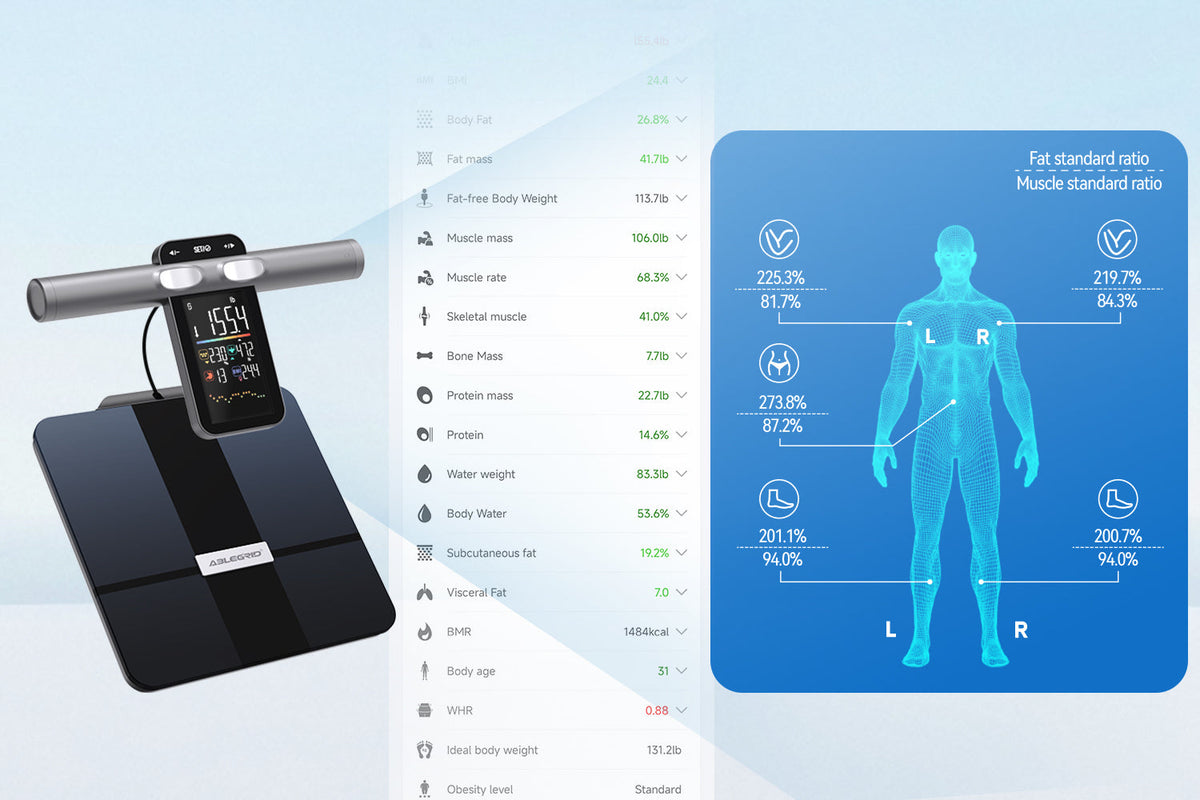
A body composition scale is most useful when you treat it as a repeatable tracking tool, not a medical test or a scorecard for one morning. Watch weight, body-fat estimates, and muscle-related estimates over several weeks under similar conditions. That approach turns ordinary day-to-day changes into a clearer picture of progress while keeping the limits of home measurements in view.
What a Body Composition Scale Measures and Estimates
Your weight is measured directly, while most of the other numbers on a body composition scale are estimates. The scale records your mass, then uses your profile and electrical measurements to produce estimates for values such as body-fat percentage, body water, lean mass, and muscle mass.
The distinction matters. A scale can be useful for noticing a direction over time without being able to give a clinical measurement of every tissue compartment. The output labels also vary by device, so treat similarly named measurements as device-specific estimates rather than values that automatically match a lab result.
| Reading | What It Can Help You Track | How to Treat It |
| Weight | Overall change from your own baseline | A direct measurement that still changes with food, fluid, and timing |
| Body-fat percentage | A possible long-term change in fat relative to total weight | An estimate that is most useful when your routine stays consistent |
| Muscle or lean-mass estimate | A possible change alongside training and nutrition habits | A model-based estimate, not a direct scan of muscle tissue |
| Body-water estimate | A reminder that hydration can affect other estimates | Context for interpreting a surprising day-to-day shift |
These categories are connected, so avoid treating one number as the whole story. If your weight stays steady while estimated body fat trends downward and your routine has been consistent, that pattern can be worth watching. It is still a reason to look at future readings, not a diagnosis or proof of a precise body change.
Which Readings Matter Most for Everyday Progress Tracking
For most people, weight and a multi-week body-fat trend are the most practical pair to review first. They are easy to record, and they can help you ask better questions about whether your daily habits are moving in the direction you want.
Weight and Rate of Change
Start with weight because it is the scale’s direct reading. Record it at a similar time of day, then compare weekly averages or a rolling seven-day average instead of reacting to the highest or lowest number.
Short-term movement can reflect meals, hydration, digestion, travel, and normal changes in stored carbohydrate. A slow pattern that appears across several weeks is usually more informative than a one-day change.
Body-Fat and Muscle Estimates
Use body-fat and muscle-related estimates as supporting context. A gradual change that appears repeatedly under the same routine can complement your weight log, especially if you are changing activity or eating habits.
Do not compare an estimate from one device with an estimate from another as if they use the same calculation. Device design and prediction equations can differ, and published methods research notes that bioimpedance results depend on the device, the equation, and the person being measured. Body-composition assessment standards explain why those conditions affect interpretation.
Context Notes
Add a brief note when a reading looks unusual. A hard workout, a late meal, alcohol, a long trip, illness, or a changed sleep schedule can help explain why a single data point does not fit your usual pattern.
That small habit keeps the data connected to real life. It also helps you avoid changing a useful routine because of noise that was never a meaningful change in the first place.
Why Trends Matter More Than One Reading
A trend is more reliable for everyday decisions because one reading can move for reasons unrelated to fat or muscle. Look for repeated movement in the same direction, measured with the same scale and routine, before interpreting a number as progress or a setback.
Create a simple review rhythm:
- Weigh under similar conditions on most days or on a repeatable schedule.
- Let the app or a notebook show your readings across at least two to four weeks.
- Compare averages and ranges, not isolated highs and lows.
- Pair the trend with training, food, sleep, and recovery notes.
- Change one habit at a time when you decide to adjust your routine.
The value of a bluetooth smart scale is not only storing a number. It is making repeated data easier to review without relying on memory. Our smart wellness tools can support that habit when you want a visible record of weight and related estimates in one place.
Daily fluid changes are one reason trends matter. A controlled study of foot-to-foot BIA found that water intake changed several body-composition estimates over a short period, which is a useful reminder that a morning-to-morning change may reflect measurement conditions. Research on hydration and BIA estimates provides a closer look at that effect.
How BIA Body Composition Estimates Work
A BIA body composition scale uses bioelectrical impedance analysis, or BIA, to estimate body composition from how your body resists a very small electrical current. Because water-containing tissue conducts differently from fat tissue, the scale combines that resistance measurement with profile information and an internal equation.
What the Scale Detects
The scale detects electrical impedance, not body fat or muscle directly. Technical background on bioelectrical impedance analysis describes how an impedance value is converted through assumptions about body water and fat-free mass.
That is why the output is an estimate. The equation may work well enough for a consistent personal trend, yet it cannot remove every difference in hydration, body shape, posture, or the device’s own model.
What Can Shift an Estimate
Hydration, recent food or drink, exercise, skin temperature, and time of day can change the path of the current or the assumptions behind the estimate. Research on acute fluid intake and BIA supports keeping measurement conditions similar when you want comparisons that are easier to interpret.
This limitation is normal for an at-home smart fitness scale. It does not make the tool useless. It tells you what the tool is best at: repeated observation under repeatable conditions.
A Consistent Smart Scale Routine for More Useful Comparisons
The most useful routine is simple: measure at the same point in your day, on the same hard and level surface, before the usual factors that shift hydration and digestion. Consistency reduces avoidable variation, so your record is easier to read.
Use this practical routine:
- Place the scale on a hard, flat floor rather than carpet or an uneven mat.
- Measure at a similar time, such as after using the bathroom and before breakfast.
- Stand still with clean, dry bare feet placed as the device instructions show.
- Avoid comparing a routine morning reading with one taken right after a workout, sauna session, large meal, or unusually high fluid intake.
- Keep the same user profile and the same device when reviewing a trend.
- Sync promptly and check that the date and profile are correct before drawing conclusions.
The goal is not to create a perfect laboratory setup. It is to make your own data comparable enough that a genuine pattern has room to stand out. If you miss a day or measure later than usual, keep the entry and note the difference instead of trying to force the record to look uniform.
When a Consumer Scale Is Not the Right Tool
A consumer scale is not the right tool when a single estimate would direct medical care, diagnose a condition, or settle a concern about unexplained symptoms. Bring those questions to a qualified healthcare professional, who can choose an assessment method that fits the situation.
Use extra caution when fluid balance is changing because of a medical condition, treatment, or medication. Review articles describe meaningful individual prediction error for BIA-derived muscle-related values, particularly when body composition or hydration differs from the assumptions behind the device. A review of muscle-mass measurement limits explains why clinical context matters.
Follow the scale’s safety instructions for implanted medical devices and other contraindications. If your clinician has given you a monitoring plan, that plan should take priority over a consumer app or scale display.
How to Choose a Smart Scale for Your Tracking Goals
Choose a smart scale that makes your preferred routine easy to repeat, rather than one that simply promises the longest list of metrics. A clear display, reliable syncing, readable trend history, and profiles that fit your household can matter more than a single extra estimate.
Use this checklist before deciding:
- Check that the scale’s weight capacity fits the intended user.
- Confirm whether it records readings offline and syncs later.
- Look for a display and app history you will actually review.
- Verify the connection method, such as Bluetooth or Wi-Fi, works with your phone and home routine.
- Review profile support if more than one person will use the scale.
- Read the safety information and return policy before purchase.
The right choice supports a stable habit. When the setup is easy, you are more likely to collect comparable readings and use them with the patience that body-composition data requires.
Build a Better Picture With Consistent Data
Use your body composition scale to notice direction, not to judge one day. Start with a repeatable weigh-in routine, review trends over weeks, and keep daily context in view when a number surprises you. A smart scale can make progress easier to see when its estimates are paired with consistency, realistic expectations, and professional advice when health decisions are involved.
Frequently Asked Questions
Q1: Can two people get different body-fat estimates at the same weight?
Yes. Body-fat estimates can differ because people at the same weight may have different body proportions, hydration, and device profile details. A scale’s equation uses more than body weight, so the most useful comparison is usually each person’s own trend rather than another person’s reading.
Q2: Should I use body composition readings during pregnancy?
Ask your prenatal care team first. Pregnancy changes body water and body composition, which can limit how a consumer estimate should be interpreted. Follow the device instructions and your clinician’s advice rather than using a scale result to make health decisions.
Q3: Can I use a smart scale with a pacemaker or implanted device?
Check with your clinician and follow the scale’s instructions before use. BIA devices use electrical current for their estimates, and device-specific safety guidance can differ. Do not assume that a general consumer feature is appropriate for every implanted medical device.
Q4: Why does my body-fat estimate change after travel?
Travel can change sleep, meal timing, activity, hydration, and time of measurement. Any of those factors may affect a BIA estimate or your body weight for a day or two. Resume your usual routine and judge the next few weeks of readings instead.
Q5: Is a Bluetooth connection necessary for a body composition scale?
No. Bluetooth is useful when it makes it easier to save and review trends, but it does not make the estimate inherently more accurate. Choose the connection option that helps you keep a consistent record without making the routine harder to maintain.


Leave a comment
This site is protected by hCaptcha and the hCaptcha Privacy Policy and Terms of Service apply.